University of Michigan Family Journal · October 17, 2026
Ten for the Care.
Seven Overall.
Let’s Connect the Two Wheels.
Views: …
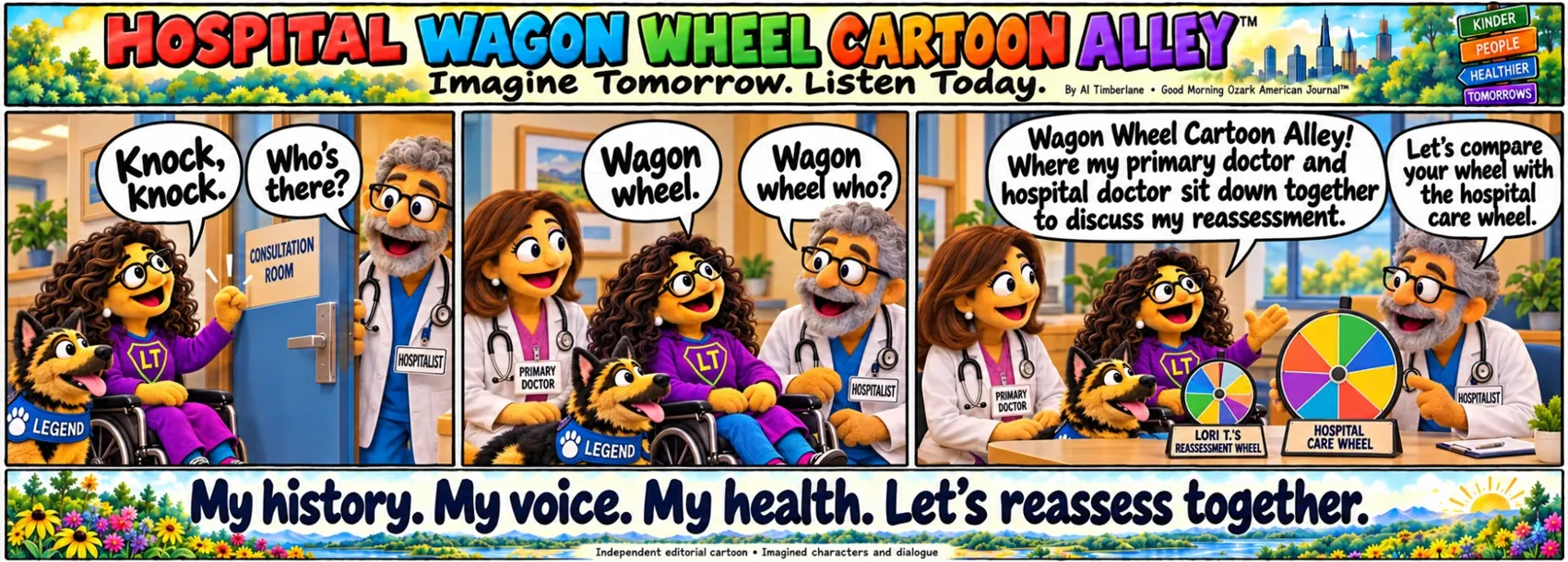
Good morning, everybody! We believe. We care. And today, we’re bringing a little sunshine, a wagon wheel, and a father’s honest report card to the conversation about hospital care.
First, a big thank-you to the people caring for Lori at the University of Michigan Hospital. There is a lot here to appreciate: skill, dedication, professionalism, the nurses who keep showing up, and the people who keep a busy hospital clean and working. Our family sees that work.
Ten for so much of the care. Three points off for the missing connection in Lori’s reassessment.
These are Al Timberlane’s and his family’s personal ratings of their experience with Lori’s care, including the inpatient hospitalist or clinician experience. They are not an official hospital score, a clinical audit, or a rating of every clinician. The overall score is our judgment, rather than a mathematical average of the categories below.
A thank-you with the scores beside it
| Category | Our rating |
|---|---|
| Thoroughness, professionalism, and dedication in the care we observed | 10 / 10 |
| Hospital care and clinical work | 10 / 10 |
| Nurses and staff | 10 / 10 |
| In-house general cleaning | 10 / 10 |
| Hospital building maintenance | 10 / 10 |
| In-house reassessment, clinical opinions, collaboration, and consults | 10 / 10 |
| Connecting reassessment with Lori’s history, her voice, and her outside primary clinician | 7 / 10 |
| Overall family experience | 7 / 10 |
Why seven when we have handed out so many tens? Because the concern that remains is central to what we hoped reassessment would accomplish. We wanted the hospital’s excellent resources and Lori’s individual history brought together in a review we could understand—and connected to a workable plan for home.
1. The big wheel: the hospital
Imagine the hospital as a large wheel. Around its rim are the services it can bring together: nurses, surgery, specialists, pharmacy, rehabilitation, care coordination, and discharge planning. At the hub is the hospital team currently responsible for the patient. The hub can change as responsibility moves from one team to another.
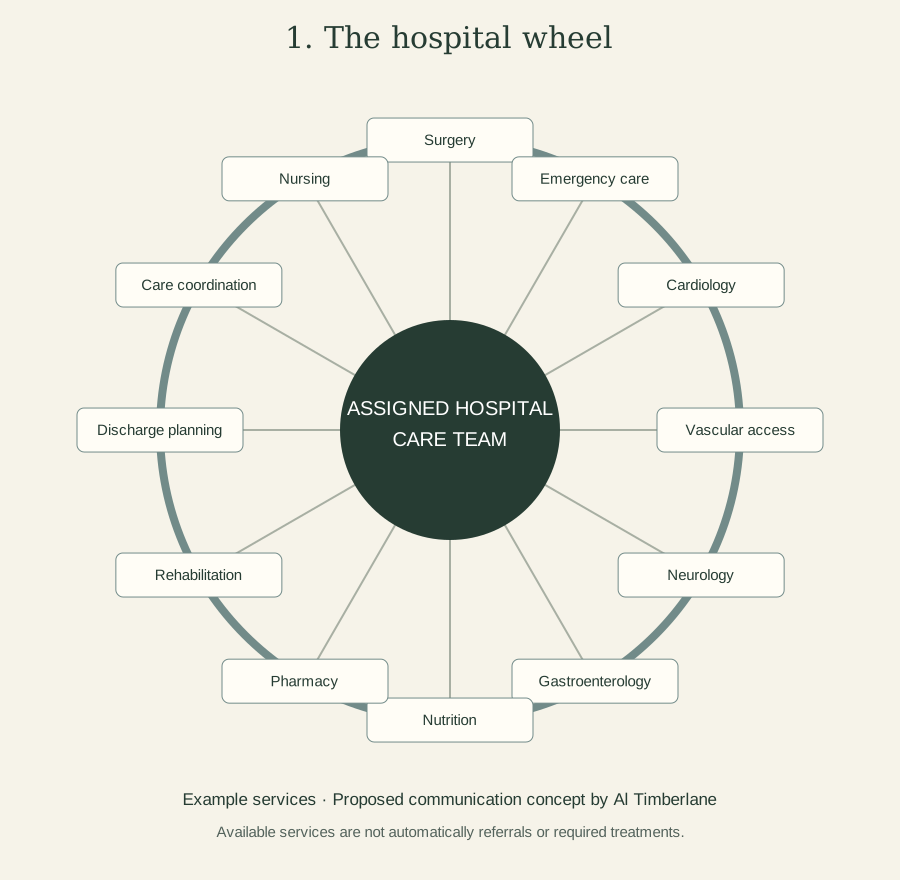
That is an impressive wheel! In our family’s rating, its in-house reassessment, opinions, collaboration, and consults receive ten out of ten. Our concern is how that wheel connects to the person bringing a lifetime of experience through the hospital doors.
2. The smaller wheel: Lori’s life and history
The second wheel belongs to the patient. In this example, it belongs to Lori. It carries her relevant history, earlier procedures, access records, medication experiences, symptoms, usual support, established care relationships, and questions about what happens at home. Another patient would bring a different wheel.
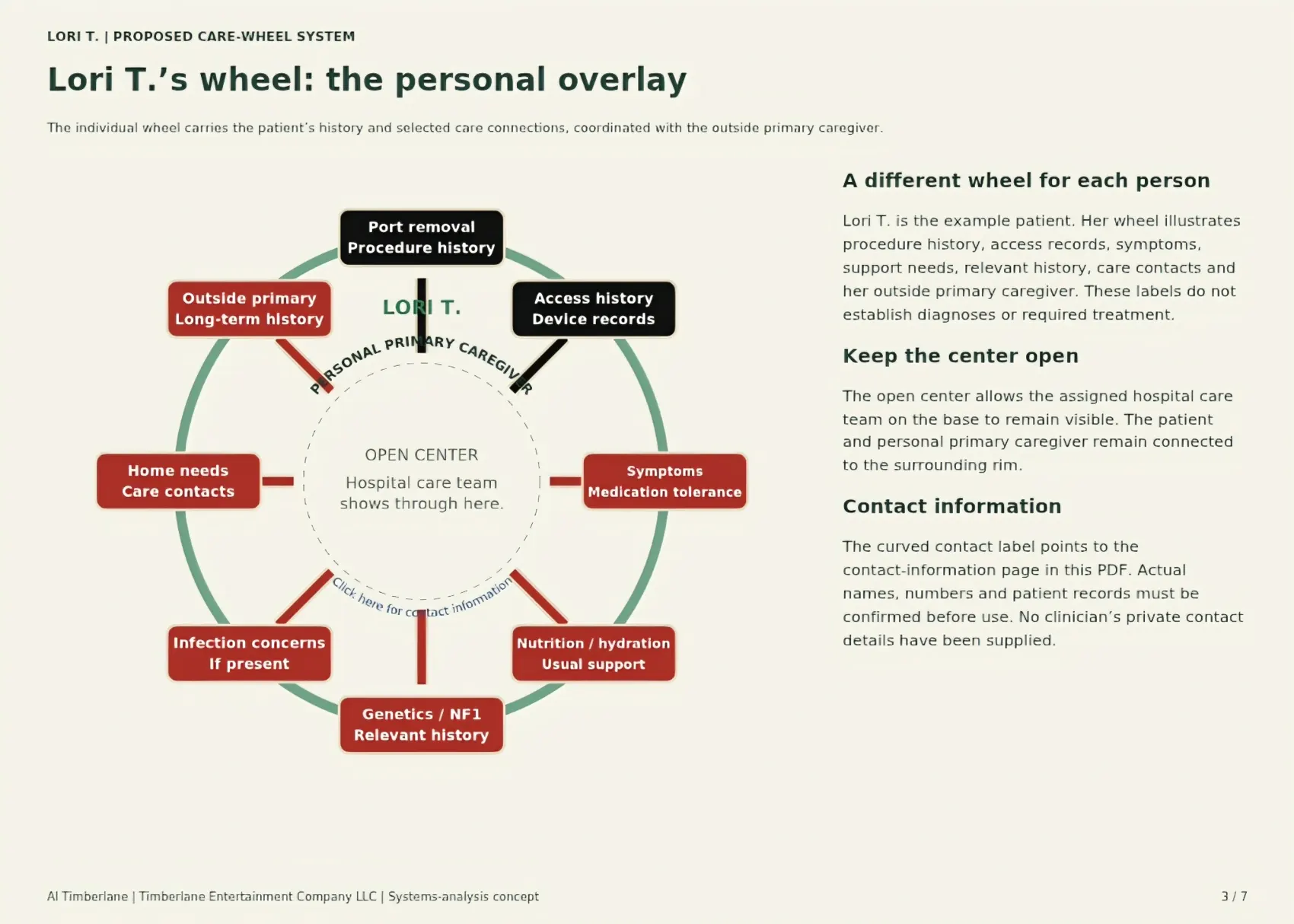
Her outside primary clinician belongs in that conversation because an established care relationship can hold years of observations and context. Lori belongs there because she lives the experience. Family members can contribute what we have observed and help identify records and unanswered questions.
Why does history matter to us? Because a hospital stay is one chapter in a much longer book. We want the team to understand what life was like before admission, what support was already in place, what changed, what has been tried, and what concerns remain. History gives us a starting point for asking better questions. It also lets us explain what “ready for home” means in Lori’s actual daily life.
We are asking for that information to be considered and for the reasoning to be explained. Sharing history does not automatically mean a particular treatment must follow. But we want to know what was reviewed, how it affected the assessment, and why the plan did or did not change.
3. Put the wheels together
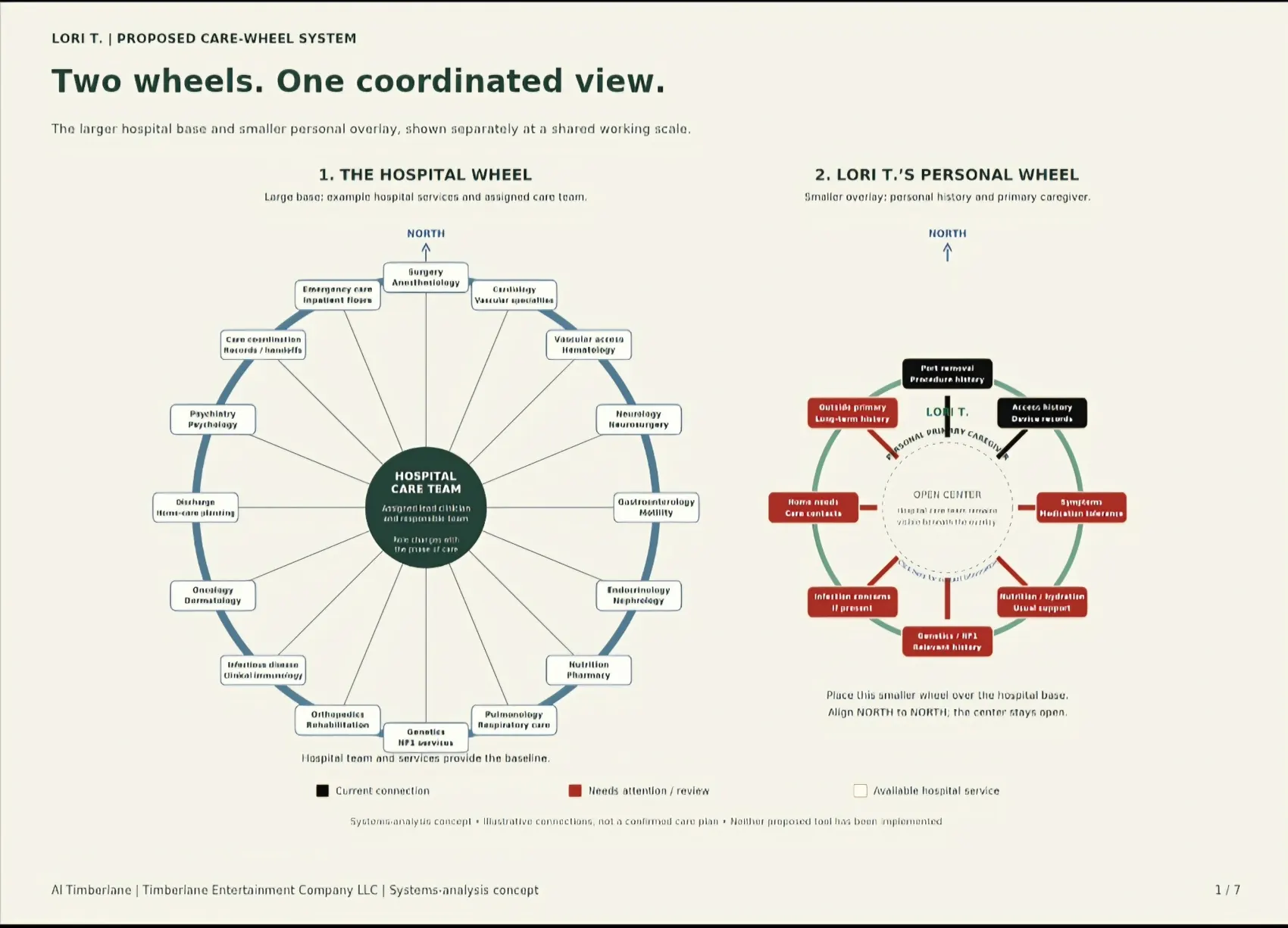
Now imagine placing the smaller wheel over the larger one. Line up the centers and the north arrows. The personal wheel has an open center, so the assigned hospital care team remains visible underneath. The patient, outside primary clinician, family, and inpatient team can see the information in one coordinated view.
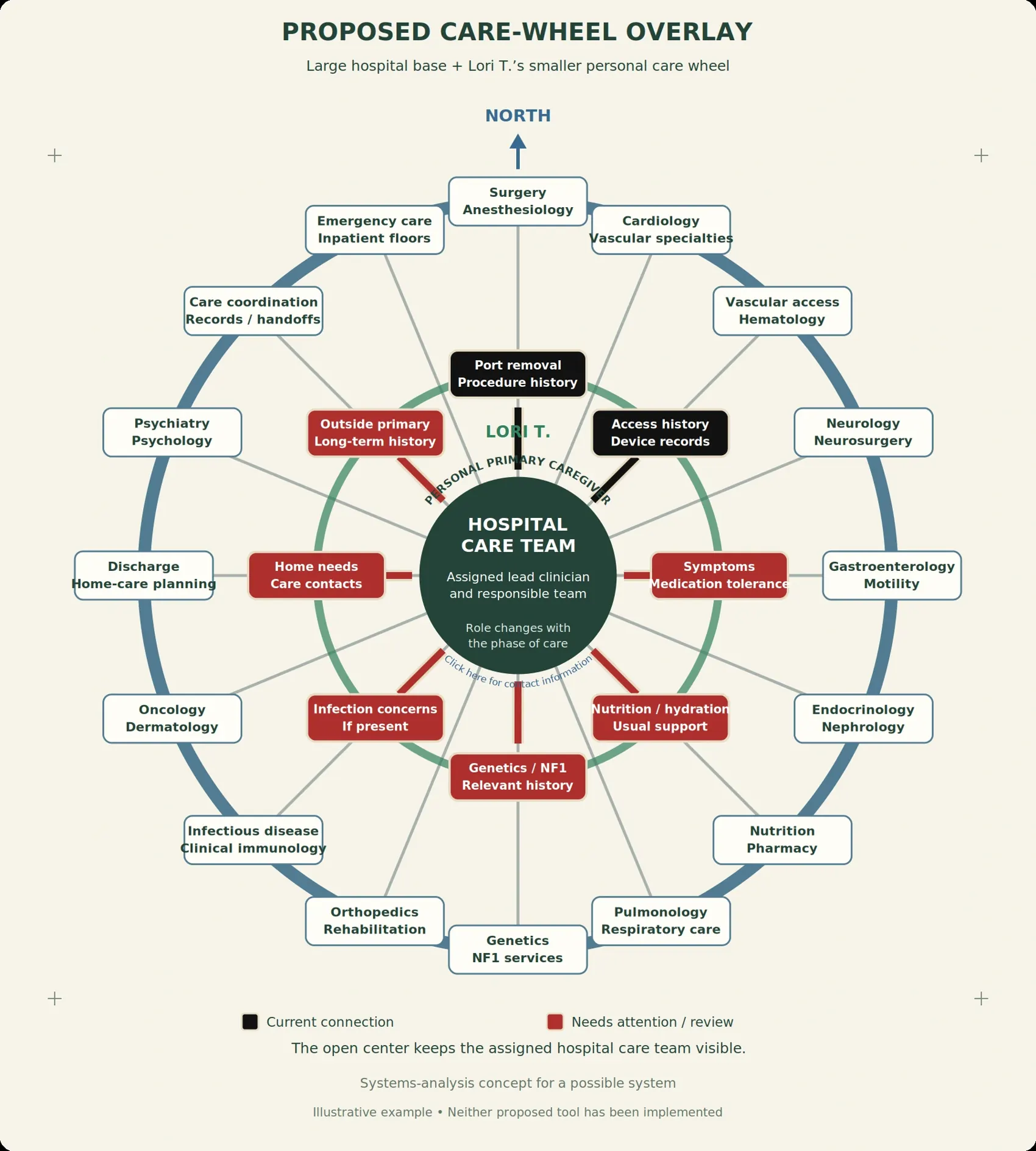
The useful work happens in the conversation: Which records are available? What needs checking? Has the outside clinician’s input been considered? What does Lori say is still difficult? Who owns each next step? What will the plan look like when she leaves the hospital?
This wheel is my proposed communication tool. It has not been implemented as a clinical system. Aligning two drawings cannot produce a medical conclusion; the people involved must review the information, make decisions, and explain the resulting plan.
4. The missing connection—and our three-point deduction
What our family felt was missing: a shared reassessment connecting the two wheels, with the reasoning and next steps explained.
In our experience with the particular hospitalist or clinician involved, the in-house assessment appeared to carry the decision while the outside history and primary clinician’s perspective did not appear to change it. We shared history. We remained disappointed because we did not see the alteration or explanation we hoped that fuller review would bring.
Our family came away feeling that the in-house team was treated as the primary authority during admission and that the outside care relationship was not meaningfully connected to that process. That is how this encounter felt to us; we cannot speak for every team or describe it as a hospital-wide policy.
We cannot know every internal discussion or conclude that no one reviewed any history. The gap we are describing is the shared reassessment we could see and understand: the two wheels brought together, the questions answered, and a clear explanation of the conclusion. From our perspective, that connection remained incomplete.
That is the reason for our three-point deduction. A hospital can earn our admiration for its resources and the care delivered within its walls while still leaving us wanting a better connection between its assessment and this particular patient’s life.
We believe. We care. Let’s keep the person at the center.
There is hope in this idea. Hospitals already bring together remarkable people and knowledge. Our invitation is to make timely reassessment a visible conversation that includes the patient’s history, established clinicians, present needs, and the practical plan for what comes next.
We want patients to enter with excellent care and leave with the support they need—or a clear, realistic plan that gives them the tools to pursue the best quality of life possible. That plan should explain responsibilities, follow-up, unresolved questions, and how the patient can get help when something changes.
Thinking back to the Taubman building and the generosity it represents, here is the message I take away: don’t forget the patient. Those are my words for the lesson, rather than a quotation from the building’s plaque.
So, thank you to the nurses, clinicians, staff, cleaners, maintenance workers, and everyone helping Lori through this chapter. There is plenty of room for gratitude and a request to connect the wheels. Let’s give that missing connection the same attention as everything we already admire.
We believe. We care. Let’s reassess together.
— Al Timberlane