By Al Timberlane · Timberlane Entertainment Company LLC
The Reassessment Wheel: An Open-Source Proposal for More Connected Patient Care
v>The Reassessment Wheel: An Open-Source Proposal for More Connected Patient Care
Views: …
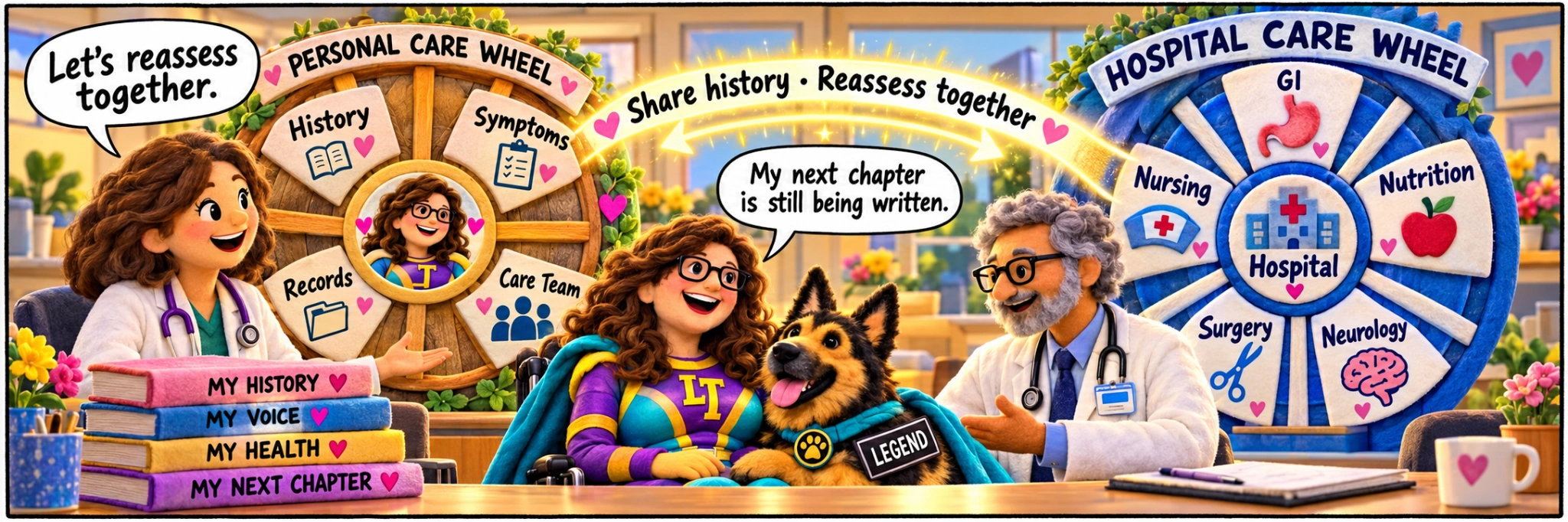
This proposal grew out of our family’s experience seeking reassessment of my daughter Lori’s care. From our perspective, that reassessment appeared incomplete. We wanted her long-term history, her outside primary caregiver’s knowledge, her current symptoms, and her needs at home considered together.
That experience led me to a systems-analysis question: How can a hospital connect its resources with the history and needs of one particular person?
The reassessment wheel is my proposed first step toward answering that question. It is a concept for an evaluation and communication system that could be developed through careful practical use, feedback, and refinement.
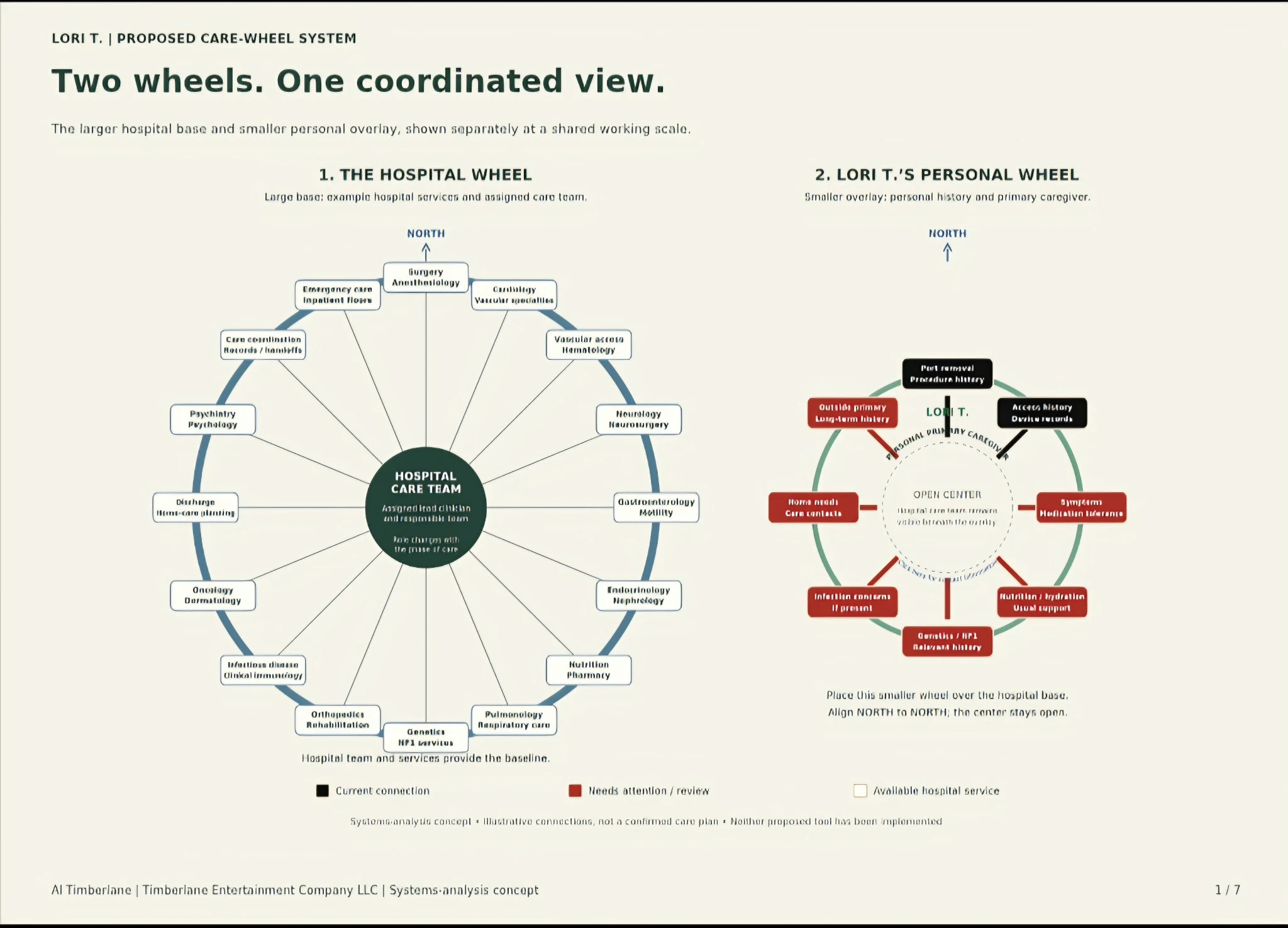
The idea begins with two wheels.
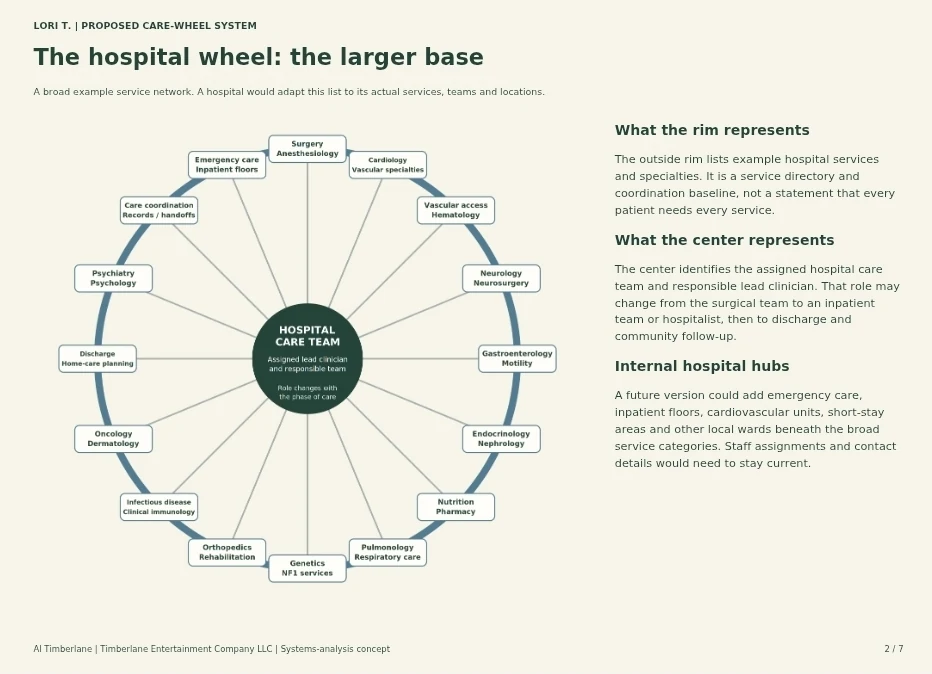
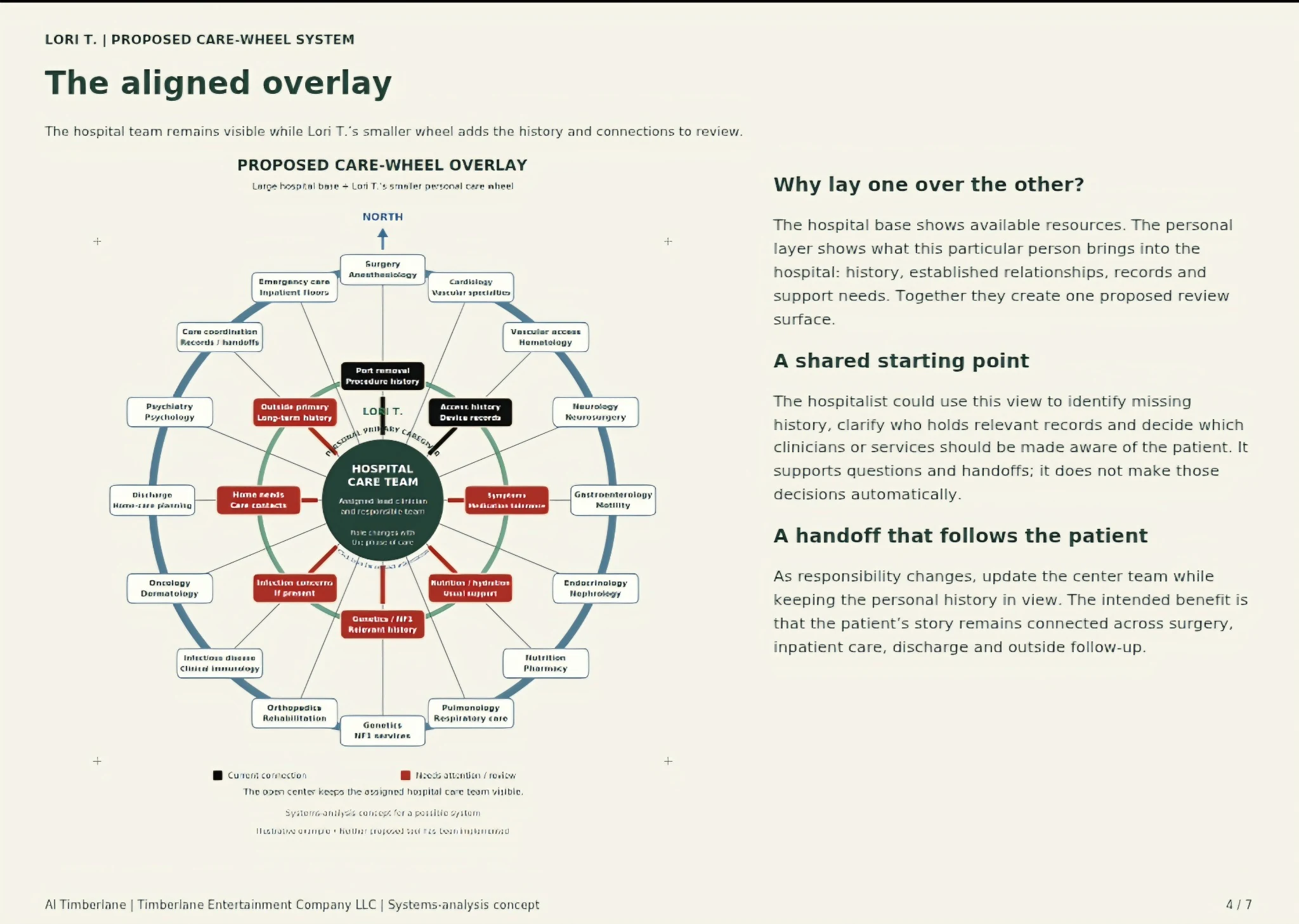
The larger wheel represents the hospital system. Around its outside rim are the services and specialties available within that hospital or its connected network. These might include surgery, emergency care, cardiology, vascular access, gastroenterology, neurology, nutrition, pharmacy, rehabilitation, care coordination, and discharge planning.
The hospital wheel could also include internal areas such as inpatient floors, cardiovascular units, surgical recovery, and short-stay units. Each hospital would build its wheel around its actual organization and available services.
At the center is the hospital care team currently responsible for the patient. That responsibility may change during a stay. The surgical team may begin the process, a hospitalist or another inpatient team may assume responsibility, and outside clinicians may take over after discharge. The center would change to reflect those assignments.
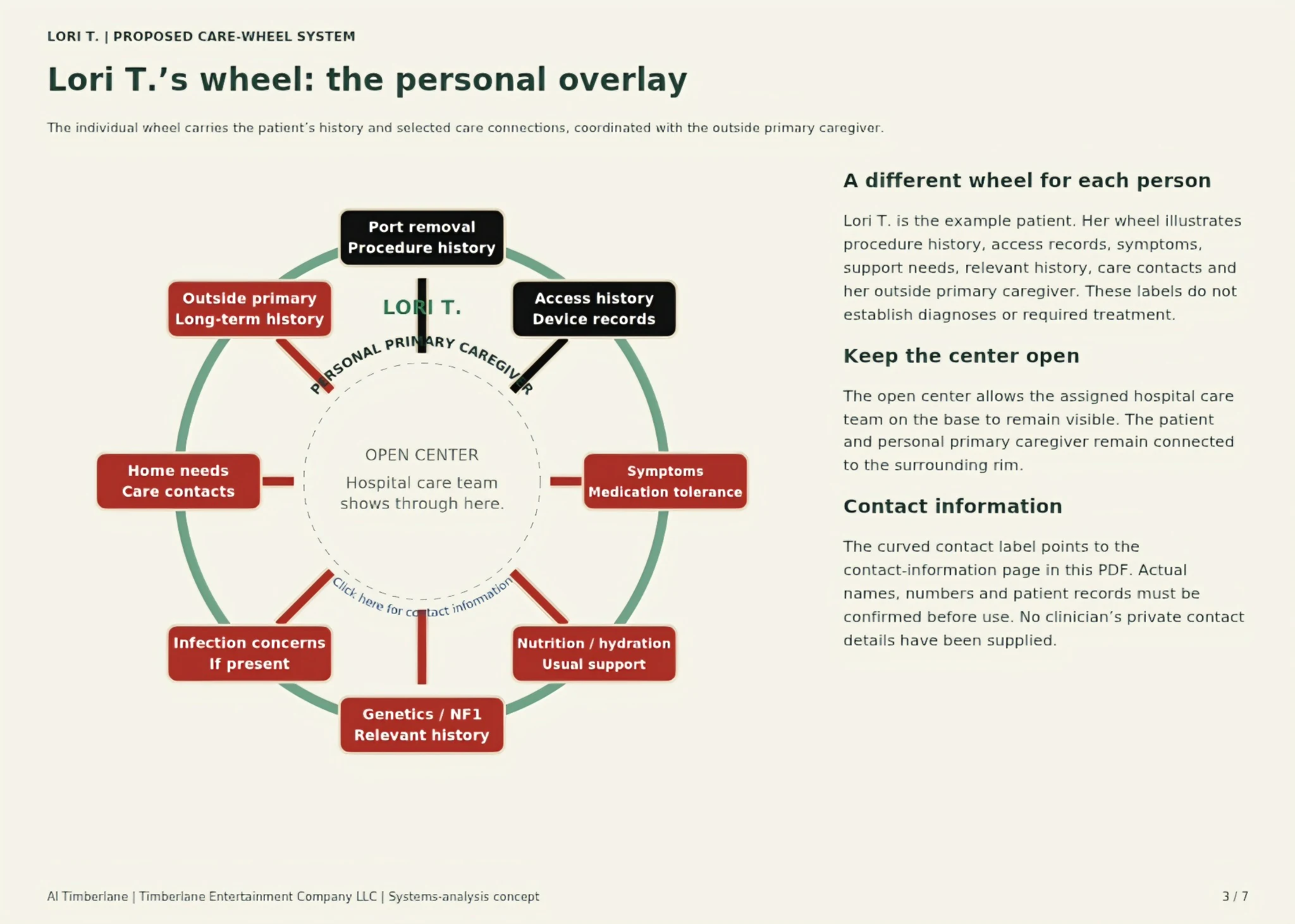
The smaller wheel represents the individual patient. In these illustrations, that person is Lori T.
Her wheel carries the history, established care relationships, records, symptoms, and support needs relevant to her. Another patient would have a different wheel. Like a fingerprint, the combination would be specific to that person.
The personal primary caregiver belongs within this wheel because that clinician may hold knowledge developed over years of caring for the patient. Along the rim of the open center would be the primary caregiver’s role and a way to reach verified contact information.
The personal wheel’s center remains open. When it is placed over the larger hospital wheel, the assigned hospital care team stays visible underneath. The hospital’s resources and the patient’s individual history can then be considered in one coordinated view.
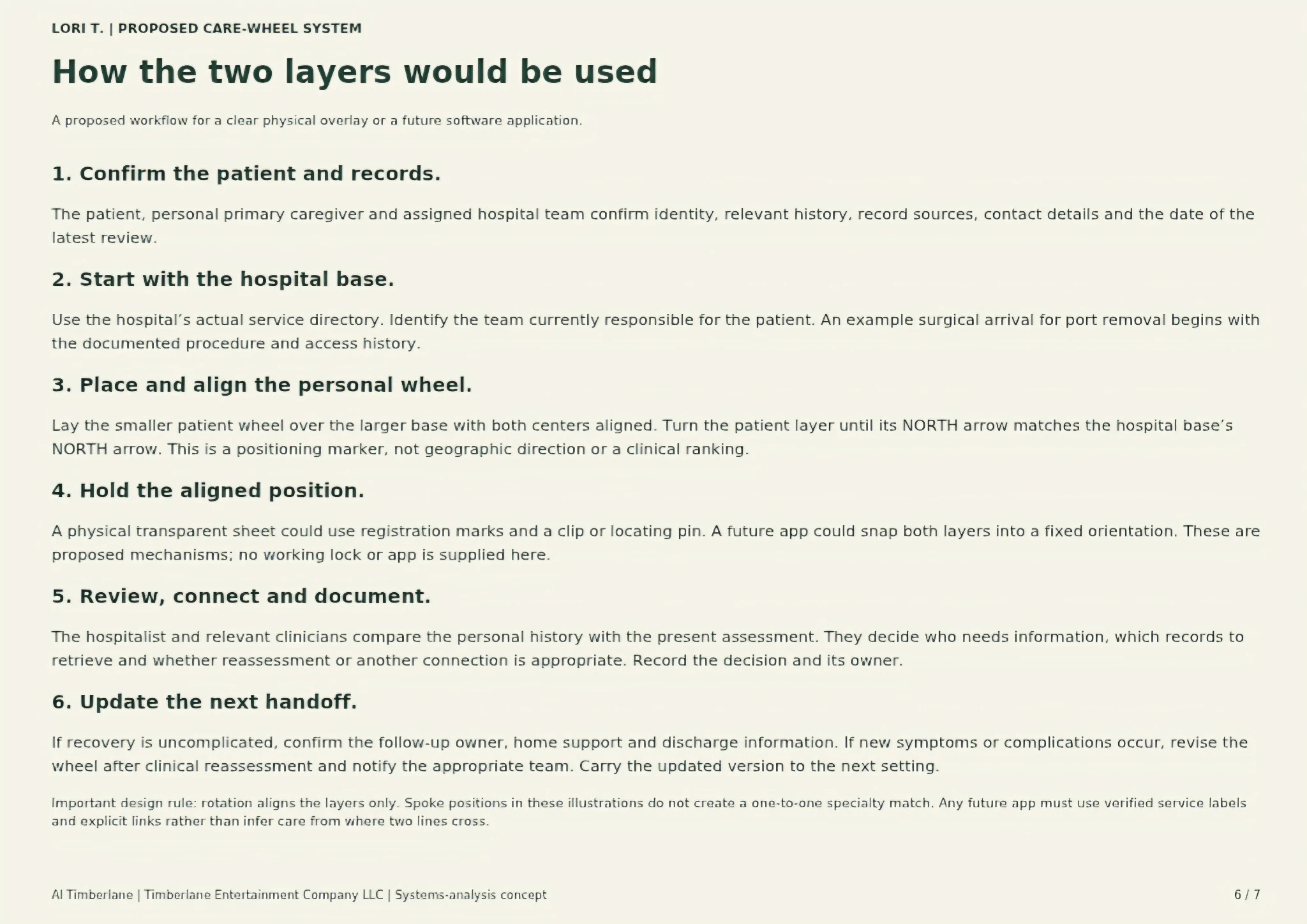
Both wheels have a simple NORTH positioning arrow. The centers are aligned, and the personal wheel is turned until the arrows match. The layers could then be held in place using clear physical sheets or, eventually, software.
The alignment provides a consistent position for viewing the information. It does not determine treatment or establish a clinical connection merely because two spokes cross. Those connections must be identified, verified, and reviewed by the people involved.
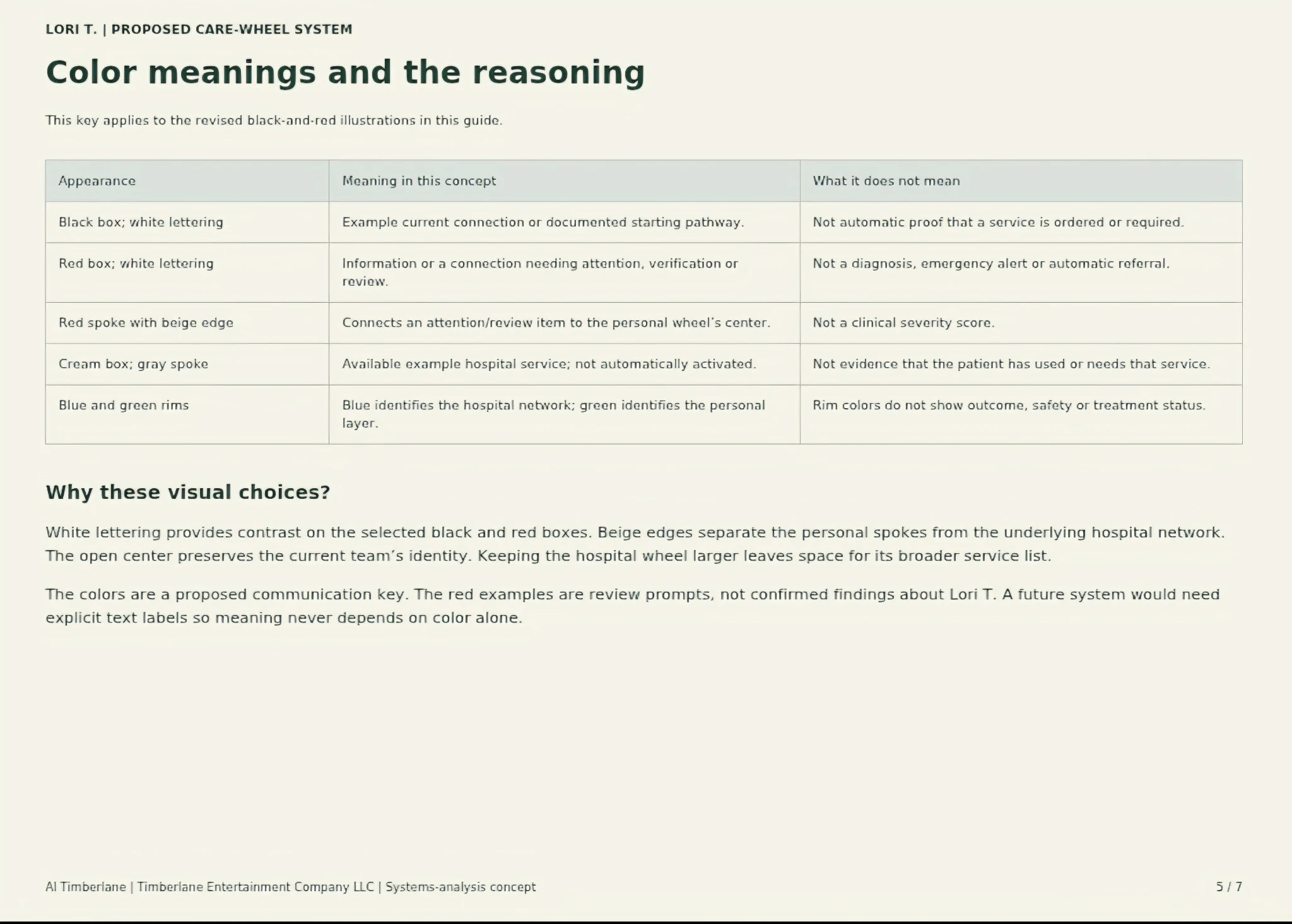
The revised illustrations use a simple color key:
- Black boxes with white lettering identify example current connections or starting pathways.
- Red boxes with white lettering identify information or connections needing attention, verification, or review.
- Red connecting lines with beige edges make those review connections visible against the hospital network.
- Cream hospital boxes with gray spokes represent available services that are not automatically activated for every patient.
Red does not automatically mean an emergency, a diagnosis, or a required referral. These are proposed communication meanings, and each connection would also need a written status.
Consider an example in which Lori enters the hospital for a procedure such as port removal. Her personal wheel would bring relevant procedure history, access records, established clinicians, and support needs into view alongside the hospital’s surgical pathway.
If recovery is uncomplicated, the team could use that shared view to clarify follow-up responsibility, home support, and the information that should accompany discharge. If complications or new symptoms develop, the wheel could help organize the questions and records needed for reassessment. The treating clinicians would determine the appropriate care.
The purpose is to give the hospitalist and other clinicians a clearer starting point: What history is available? What is missing? Who knows this patient’s background? Who needs to be informed? Who owns the next step?
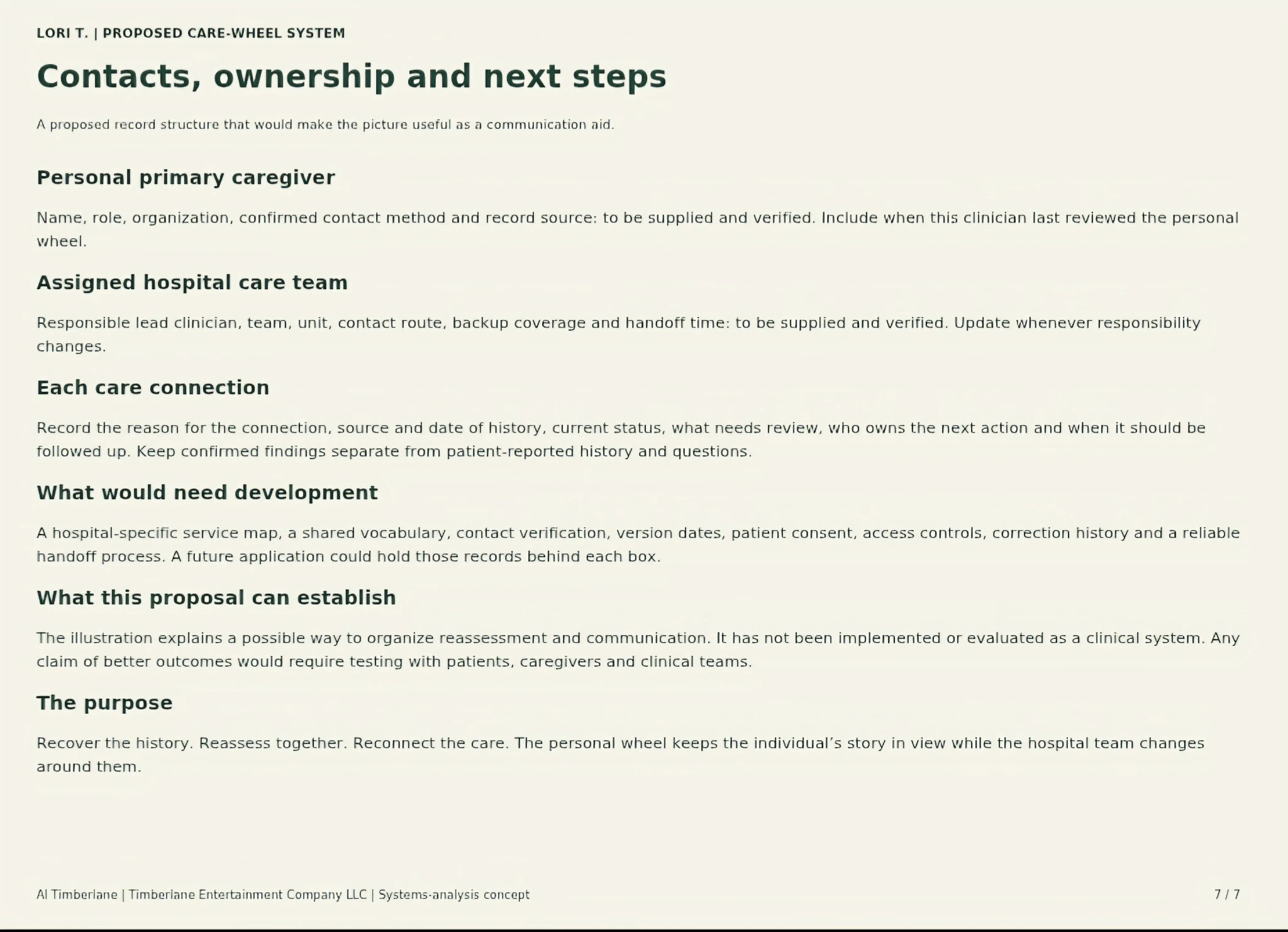
A future software version could make each box open into records, contact information, review notes, and assigned actions. A technical team could develop that application, or I could begin building a prototype myself.
A future connection with MyChart could place this reassessment view alongside the patient’s medical information. That would require technical development and cooperation with the healthcare organization.
Artificial intelligence could provide another layer of assistance. It could help organize records, identify possible gaps or conflicting information, and bring unresolved questions to the attention of the patient and care team. New information could prompt a review of the personal wheel.
AI-generated summaries and suggestions would need verification. The patient and caregivers would contribute their knowledge, clinicians would assess the information, and medical decisions would remain with the treating professionals.
My intention is for this proposed system to develop as an open-source project, allowing developers, hospitals, clinicians, patients, and caregivers to collaborate on its improvement. The software and design documentation could be shared under an appropriate open-source license so others could study, adapt, test, and improve the work.
Open source would apply to the software and shared design materials. Patient records, private contact information, and other personal health information would remain protected.
Neither of these wheels currently exists as an implemented clinical system. This is a proposed first step. A carefully planned pilot could help reveal what works, what is missing, and what a complete system would require.
The aim is to keep the person’s history connected as responsibility moves through a large hospital system—and back home again.
“Recover the history. Reassess together. Reconnect the care.”
Al Timberlane
Timberlane Entertainment Company LLC
The proposal in seven illustrations
Select any illustration to open the complete image at full size.
 Support & sponsorship · Counters & privacy · Usage & permissions
© 2026 Timberlane Entertainment Company LLC
Loading page views…