Good Morning from Willis, Michigan
Views: …
Good morning, everyone. I’m Al Timberlane.
This morning we are in Willis, Michigan, staying with my son Joshua and my daughter-in-law Morgan at their country home.
It is comfortable out here. They are in the middle of building a chicken pen. They have grapes growing, a large garden, and plenty of room around the property. It has that relaxed country feeling that reminds me a little of home in the Ozarks.
Becky and I are staying in the extra living quarters downstairs. It is a large space—I think somewhere around 3,000 square feet—and ordinarily this is where Lori T. lives.
Right now, though, Lori T. is still in the hospital.
She has been there for quite a few days, and one of the reasons Becky and I came north was simply to be here, visit her, listen, and provide some moral support while a complicated medical situation continues to unfold.
This first-person account reflects our family’s recollections and questions about Lori T.’s care. Medical details remain part of the record we are working to understand.
Why Is My Daughter Crying?
Over the next several weeks, I plan to write a series for the Good Morning Ozark American Journal™ about Lori T., her experience, and the larger question behind it: Why is my daughter crying?
That is not meant as an attack on a hospital or on the people working there. It is a question about the system, communication, history, continuity of care, and what happens when a complicated patient moves through a very large medical center where doctors and hospitalists change and no single person seems to be following the whole twenty-year story.
A Test from 2008
One of the most surprising things we recently learned involved a gastric-emptying study that has been discussed in evaluating Lori T.’s need for medical access at home.
We discovered that the test being referenced was performed in 2008. That matters to us because Lori T.’s medical history did not stop in 2008.
I am still concerned about some lab tests and about how they were understood. There has not yet been a new gastric-emptying study or a broader follow-up evaluation of that particular issue. The discussion was subsequently closed for the time being because the team did not believe there was anything further they could offer during this admission.
At the same time, the hospital has been questioning whether Lori T. should be discharged with the type of access she has relied upon at home.
Our concern is that an old test cannot, by itself, tell the whole story of what has happened during the many years since it was performed.
The Longer History
Lori T. also has NF1, and we have been looking more closely at how NF1 can affect different systems of the body, including neurological function and, in some patients, the gastrointestinal system.
That is an area I want to research carefully before we publish our larger story. There are statistics and medical details that need to be checked so that we get them right.
What we do know from living the history is that Lori T. has experienced substantial gastrointestinal difficulties over many years.
She also relies on a service dog. Legend has an important job.
There are times when Lori T. can become unsteady or collapse, and Legend has learned to warn her before an episode. That warning can give her time to sit or protect herself from a fall.
Two things have played a major role in allowing Lori T. to remain independent at home: her service animal and reliable medical access.
The Port, the PICC Line, and the Complications
Lori T. is not insisting that a port must be returned to exactly the same location or handled exactly the same way it was before. But she entered the hospital expecting a port replacement.
During that process, the existing port was removed and a PICC line was placed.
The insertion was difficult. During the procedure, another physician was consulted, and the line was ultimately placed.
Later, the PICC migrated outward by approximately two inches. It was evaluated, and at the time we were told that it remained usable and that there was no clot identified.
As time went on, however, Lori T. began experiencing substantial pain and swelling in the chest area.
A collection developed there—Lori T. jokingly named it “Bertha.” It contained blood, fluid, and material that eventually had to be drained.
An initial attempt at drainage was extremely difficult for Lori T. She remained aware of much of the procedure and experienced considerable pain. Only a small amount was removed at that time.
Later, after further discussion, the team performed another procedure under general anesthesia, which Lori T. had specifically requested because of her previous experience.
The collection was removed. We have been told that it contained blood clot and other material, although we still have questions about precisely how it developed.
We have wondered whether the movement of the PICC or the position of its tip might have contributed to what happened, including whether medication or fluid could have gone somewhere it was not intended to go. But that remains a question—not a conclusion.
There was also an infection identified during the hospitalization. Rather than speculate about exactly where it originated, that is another part of the medical record we want to understand carefully before making any broader statement about it.
The last several days have been particularly difficult for Lori T. There was significant pain and bleeding. The doctors eventually had to take her back in and cauterize the area.
Thankfully, that part now appears to be healing properly, and the bleeding has stopped.
Her medications have also changed during the hospitalization. Lasix was stopped for a period and has now been restarted.
All of this has happened in roughly the last fifteen days.
Why We Are Here
And that brings us to where we are this morning.
We are not here pretending to be doctors. We are here as family.
We are listening. We are asking questions. We are trying to understand why decisions are being made.
And, perhaps most importantly, we are trying to make certain that twenty years of history does not disappear behind one test result, one department, one shift, or one hospitalist.
That is one of the challenges of an enormous hospital system.
There are many talented people. There are many specialists. There are many departments. But doctors rotate. Hospitalists change. Consulting teams enter and leave.
And for a complicated patient, the person who knows the entire history best may sometimes be the patient herself.
That is part of the story we will be telling.
A Better Moment: Therapy Dogs in the Lobby
Thankfully, yesterday was not entirely about procedures, tests, or hospital rooms.
Lori T. was able to come downstairs with us into the main lobby, where we met some wonderful therapy dogs.
We sat together, enjoyed the dogs, talked with the volunteers who work with them, and I recorded a short interview.
Those small moments matter. A hospital does not have to be only about illness.
Sometimes a dog walking through a lobby can change the entire atmosphere of a day.
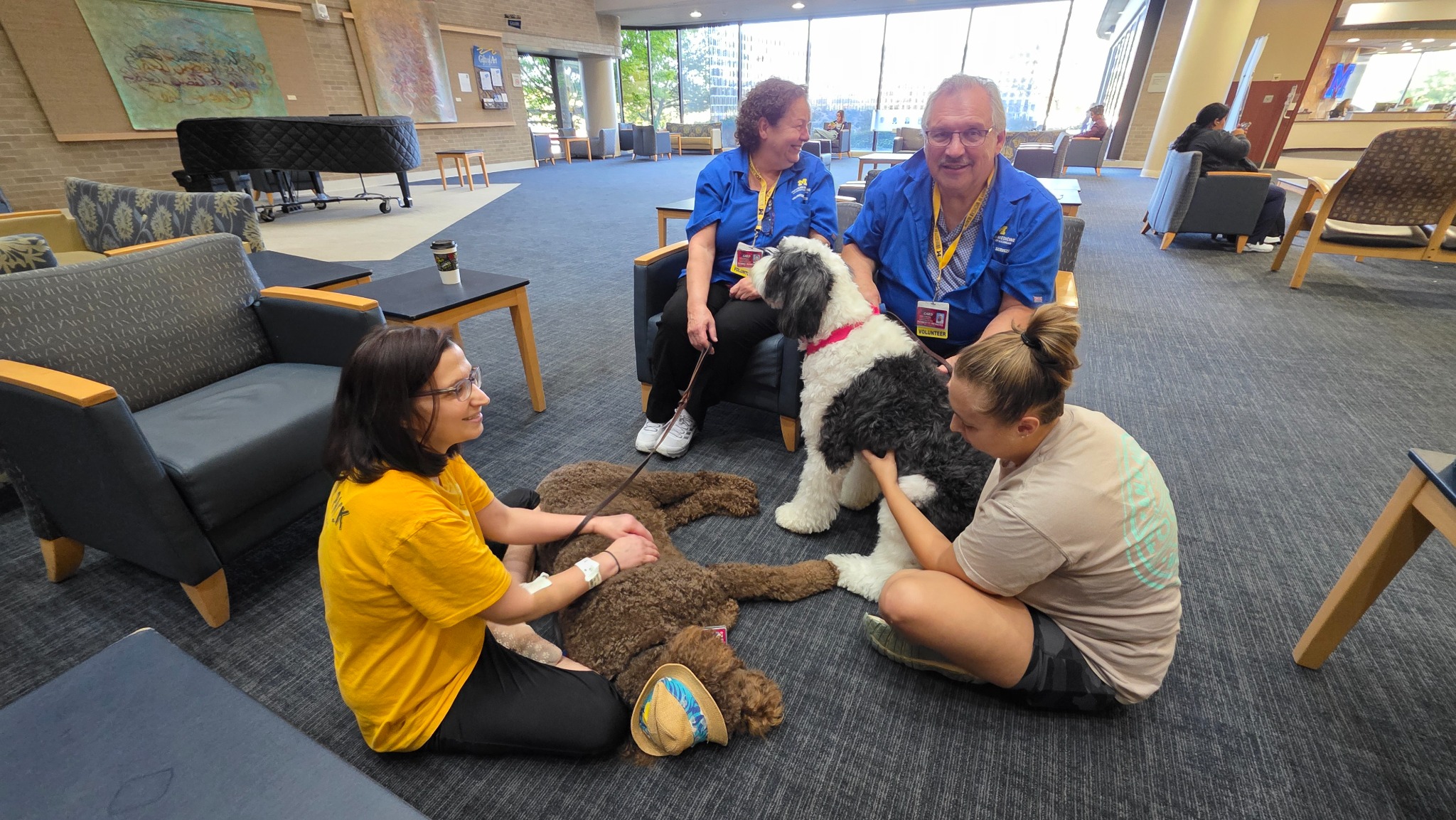
Photograph by Al Timberlane · October 12, 2026
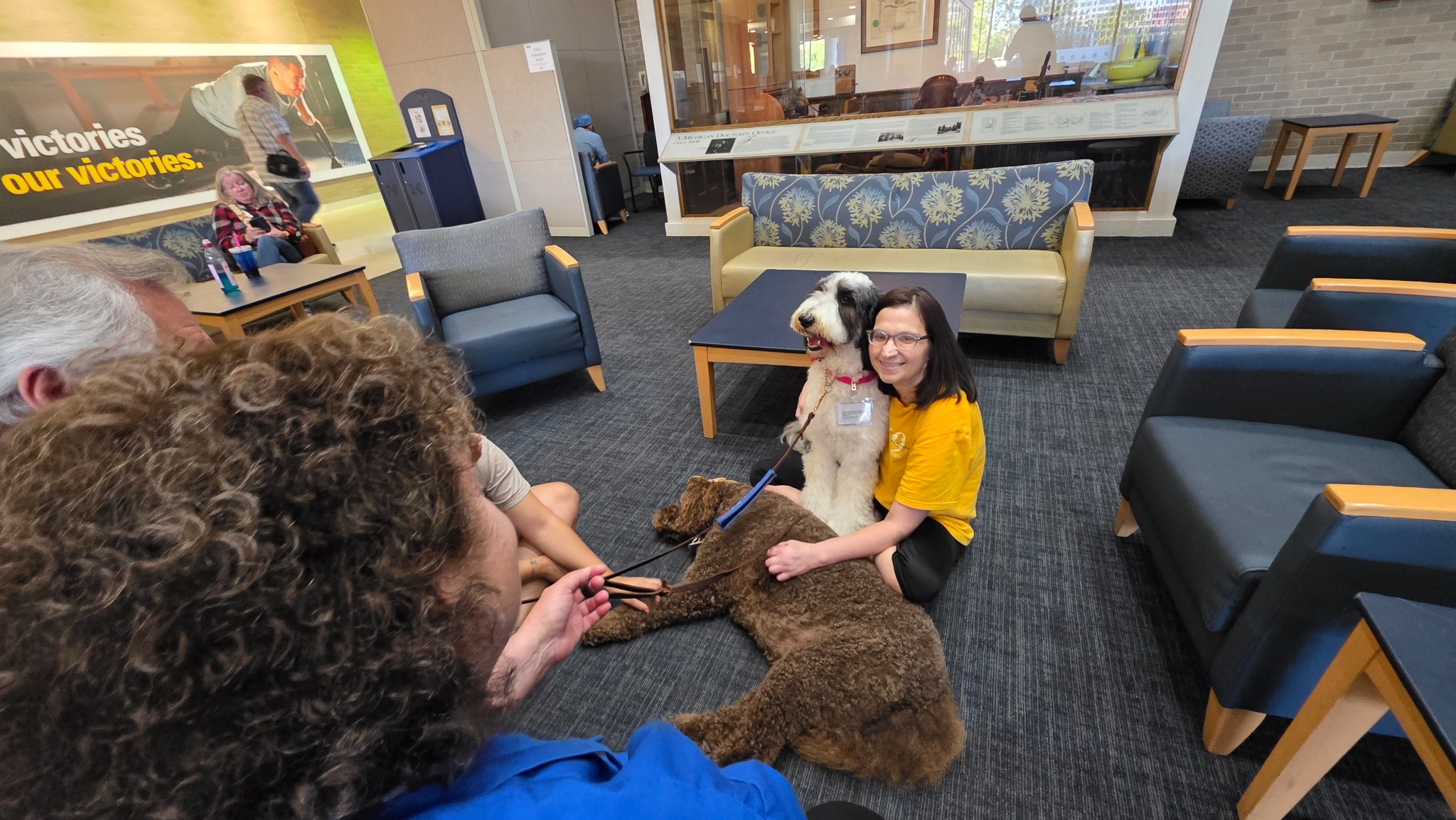
Photograph by Al Timberlane · October 12, 2026
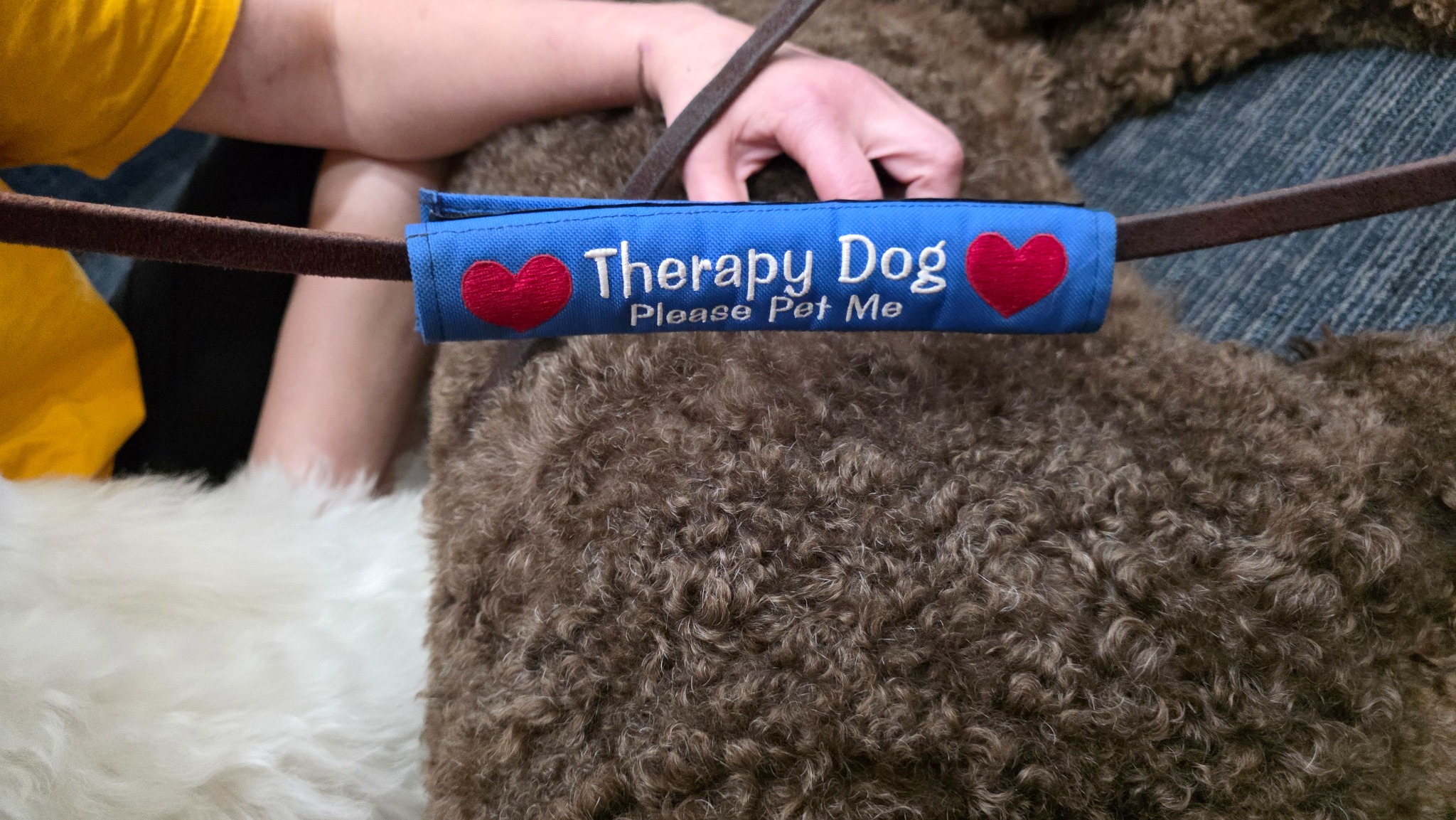
Photograph by Al Timberlane · October 12, 2026
Watch the Therapy Dog Interview
Building the Good Morning Ozark American Journal™
We will be sharing that interview through the developing Good Morning Ozark American Journal™ archive as we continue building the magazine under Timberlane Entertainment Company LLC.
The vision is for the Good Morning Ozark American Journal™ to grow beyond a simple morning entry into a larger magazine built around music, entertainment, family, travel, history, community, and the real stories of people we meet along the way.
Eventually, we hope for it to becom